
Physical Rehabilitation is an emerging field in veterinary medicine which has become very important in providing our companions the best opportunity to improve their quality of life. If your pet experiences medical conditions such as osteoarthritis, intervertebral disc disease, fibrocartilagenous embolism, orthopedic surgeries, soft tissue injuries, obesity or increasing difficulty with daily activities, your pet could greatly benefit from early rehabilitative care. We also work with healthy, active dogs who regularly participate in agility events in order to improve endurance, coordination, flexibility and strength.
At NorthStar VETS, our mission is to provide rehabilitative services for your pet provided by a team of veterinarians who are have undergone advanced study and are certified in canine rehabilitation (CCRT or CCRP). Our comprehensive approach allows us to factor in all pieces of the rehabilitation equation by looking at medical history, current problems, lifestyle, body condition, supplements, medication and owner goals in order to develop an individualized treatment program that will best meet the needs of your pet.
Goals of Physical Rehabilitation may include:
Improving joint range of motion
Improving muscular strength and coordination
Facilitating and accelerating your pets functional recovery from surgery
Decreasing swelling and pain management
Promoting physical and mental well being
Improving quality of life
Reducing the risk of injury due to deconditioning and repetitive movement in our canine athletes
Weight loss
Functional training
Fitness and conditioning
Our experts in Physical Rehabilitation use the same equipment and techniques utilized in human physical therapy centers such as:
Therapeutic exercise for improving range of motion, strength and balance
Thermotherapy (heat and ice)
Our veterinary rehabilitation service will work in conjunction with our specialists, as well as with your regular veterinarian to provide advanced care and rehabilitation for your pet.
In addition to Physical Rehabilitation, NorthStar VETS, also offers other complementary rehabilitative and pain management services like Acupuncture and Stem Cell Therapy.
NorthStar VETS is proud to offer a wide range of complementary medical services as part of its focus on total health and wellness for its patients.
Acupuncture is one branch of the ancient art of Traditional Chinese Veterinary Medicine (TCVM). TCVM promotes the belief that health is a reflection of energy balance between all parts of the body. Illness, on the other hand occurs when there is an imbalance of the body's energy force—called Qi (pronounced CHEE). It has been practiced in China for over 2000 years. It differs in many ways from the modern, conventional medical practices utilized widely in the Western hemisphere.
Qi is the life force or vital energy required to maintain health. Qi flows through the body on channels called meridians. When the Qi flow along these meridians is interrupted, there is an excess or deficiency of this energy or a blockage of the energy flow, resulting in pain and/or illness. The meridian channels contain specific points that when stimulated resolve or return the normal flow of the Qi to the body and allow healing to occur. These points are called Acupoints, and stimulation of these points is called Acupuncture.
Acupuncture therapy can be effective for your pet if they suffer from a medical condition, such as:
Adjuvant therapy for appetite stimulation
Chronic arthritis
Muscle, tendon and bone injuries
Pre and post-operative pain management
Paralysis and paresis, spinal injury and disc disease
Seizure disorders
Immune compromised patients
Adjuvant therapy for kidney and liver diseases
Cancer pain and minimization of treatment side effects
Gastrointestinal disorders
Ocular disorders
Respiratory disorders
Neurological conditions
Musculoskeletal disorders
A variety of Acupuncture techniques are commonly used, including:
Dry needling (needles placed in specific acupoints)
Electroacupuncture (electrical stimulation between points to enhance healing)
Moxabustion (use of an herb to warm the affected body area)
Aquapuncture (using injections at the acupoint sites instead of a needle)
Acupressure (manual pressure on acupoints)
Each of these techniques is used to restore normal Qi flow, encourage the body's natural balance and enhance healing and pain resolution.
It is a common misunderstanding that an acupuncture session is painful; in fact, it is quite the opposite. The needles are sterilized and extremely thin. Absolutely no chemicals are involved and complications are rare. As the needles are inserted your animal companion could feel slight discomfort; however, as treatment continues they tend to become calm and may actually hit the snooze button and fall asleep. A typical session generally takes 30-60 minutes. The number and frequency of sessions required will vary depending on the nature and severity of the pet's problem. In general, a series of sessions is required for maximum benefit.
Did you know that both humans and animals carry around a first aid kit that is used every day to heal minor bumps, bruises, cuts and more serious injuries? These cells are called "adult" stem cells and can be found throughout the body. Adult stem cells are found in all tissues (fat, muscle, bone marrow, and brain) and have the ability to self renew and become different cell types. The most common source for harvesting adult stem cells in veterinary medicine is fat.
The cells patiently wait in the body for a signal to be deployed. They will then rush to the scene of the injury and begin the healing process. Though the body is a healing machine and we have the capability to heal naturally with our own stem cells, from time to time, some injuries or diseases become chronic and fail to really heal. Sometimes the body will simply settle for creating an ugly scar or walking off the injury just to get back to life. A perfect example of this compromise is arthritis: where the body accepts the inflammation and joints still function despite the increased levels of pain.
An injury like this slowly degenerates to the point where it causes severe pain and becomes dysfunctional. This is when you would take your pet to the veterinarian or go to the doctor and generally get prescribed medications to help you live with the chronic pain and inflammation. Before stem cell therapy, this was the only option available.
But, today, more than 1,700 dogs and 3,600 horses in the United States have been treated for tendon, ligament, and joint problems over the last six years with their own stem cells! More than 70% of these pets have had significant improvement in their quality of life and can return to running, jumping, swimming, or whatever physical activity their lifestyle might demand.
NorthStar VETS is proud to be on the frontier of advanced veterinary medicine by offering adult stem cell therapy to dogs and cats. Adult stem cell therapy can be used for the treatment of osteoarthritis, polyarthritis, tendonitis, and fracture repair. Since pets donate their own stem cells, therapy is extremely safe with less than 1% of patients having an adverse reaction. Your beloved pet with bad arthritis can be treated with their own stem cells at NorthStar VETS.
Joy Weinstein, DVM, DACVS, Garrett Levin, DVM, DACVS and Laura Culbert, DVM, DACVS have received advanced training utilizing adult stem cell therapy and are currently available for consultation regarding stem cell treatment at NorthStar VETS.
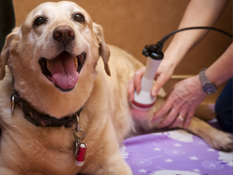
Laser therapy also referred to as photobiomodulation is the application of light in order to modify a biologic process. In short, laser therapy results in a photochemical effect at the cellular level that stimulates tissue repair, remodeling and regeneration. Depending on the wavelength, power and other factors, light can cause beneficial or harmful effects in cells and tissue. Lasers can be used to stimulate favorable therapeutic effects in tissue. These include: enhanced wound healing, accelerated tissue regrowth, reduction in scar tissue formation, nerve cell regeneration, reduction in inflammation, reduction in edema and swelling, increased blood circulation to treated area, and modulation of pain.
Photobiomodulation is finding increasingly more applications in the veterinary medical field. Conditions ranging from the treatment of skin disorders (anal sacculitis,ear hematomas, hot spots, acral lick granulomas) to post operative orthopedic rehabilitation, to the management of chronic pain and osteoarthritis have been shown to benefit from the therapeutic effects of laser treatment.
Within the veterinary rehabilitation field, laser therapy is routinely utilized as part of a pain management plan. Whether an acute musculoskeletal injury, post-surgical trauma or chronic osteoarthritis the use of photobiomodulation is providing patients with consistently positive and effective therapeutic results. The mechanism of pain relief is thought to be due to several mechanisms, including: increased secretion of seretonin, increased release of endogenous opiates, and blockage of pain recognition within the nerve pathways.
Therapy Lasers have been scientifically proven and successful in treating post-surgical pain and many acute and chronic conditions, including:
Wounds
Cuts/ Bites
Inflammations
Tooth Extraction Pain Relief
Sprains, Strains & Fractures
Post-Surgical Healing / Pain Relief
Degenerative Joint Disease/ Osteoarthritis
Periodontal Disease
Lick Granulomas
Tendonitis
Depending on the disease process, laser treatment can be a single, one time application or require a series of sessions. Often a series of sessions is required to achieve a long lasting effect since the therapeutic benefits from laser therapy are cumulative (ie build on each session). However, once the initial induction phase is completed the maintenance phase of treatment can be as minimal as one laser session a month.
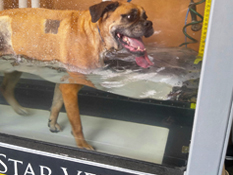
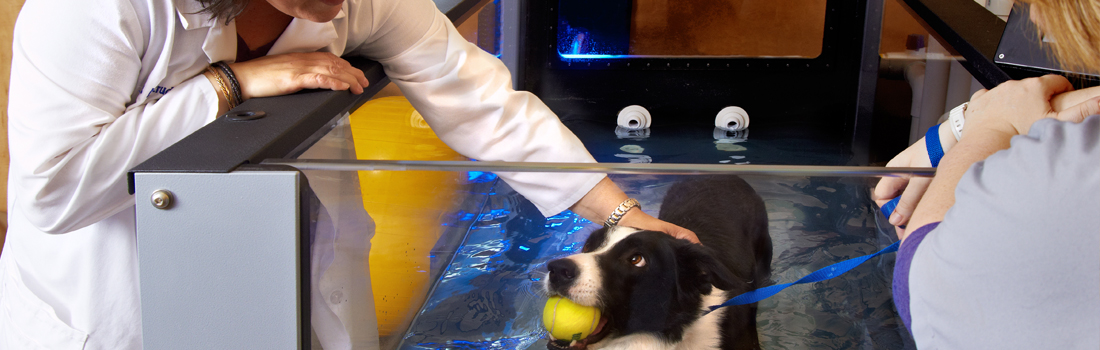
Aquatic - or water- therapy utilizes the physical properties of water to aid the patient in healing and in successfully returning to normal function.
Water's physical properties include: relative density, buoyancy, hydrostatic pressure, viscosity/resistance and surface tension. Relative density and
buoyancy determines the amount of weight a patient must carry in the water. While in water, patients bear less weight which reduces the stress
and load on painful limbs and joints, allowing more effective movement. Hydrostatic pressure refers to the pressure water places on the body, this
pressure helps reduce swelling/edema and improves blood circulation. Exercising through water's resistance aids in muscle strengthening, improves
balance and coordination and promotes cardiovascular retraining. Additionally, the temperature of the water (usually between 88 and 92 degrees)
relaxes muscles, releases endorphins (natural pain modulators) and improves circulation.
The underwater treadmill is one of the most valuable and commonly used piece of equipment in aquatic therapy.
This modality is used as part of the rehabilitative program to successfully:
Improve balance, strength and coordination
Improve joint function
Improve mobility
Promote weight bearing
Enhance overall fitness/weight management
Re-educate the body to normal limb function
There are many conditions that can benefit from the use of underwater treadmill/aquatic therapy including: osteoarthritis, degenerative myelopathy,
disc disease, post orthopedic surgeries, and many neurologic conditions. Most patients – young and old- become accustomed to using the
underwater treadmill. However, there are certain medical conditions that preclude the use of aquatic therapy. A rehabilitation practitioner will make
a decision on using this modality based on : evaluation of the patient, discussion with the owner, established rehabilitative goals, and concurrent
medical conditions.
Aquatic therapy can be used for the overweight patient as part of a weight management program. As well as for the athletic patient to optimize
conditioning and training.
Kobie's Story:
Purchased from a pet store at 9 weeks of age, cage confined at pet store. New owner noted abnormality in forelimb confirmation and gait.
Owner immediately consulted with orthopedic specialist at NSV. Diagnosed with bilateral carpal contracture and digital flexor tendon laxity. This
condition most likely was secondary to excessive cage confinement prior to purchase.
Kobie was referred to the Rehabilitation Department for evaluation and therapeutic plan.
Kobie's carpus was bowing forward and hyperflexing and his digits were hyperextending – both forelimbs
were affected. Kobie also walked with her elbows flexed which was causing discomfort in her elbows and shoulder muscles .As a result of her
abnormal gait, her forelimb and shoulder muscles were atrophied.
Along with a daily home program of strengthening and stretching exercises, underwater treadmill therapy was started weekly.
Steady and progressive improvement was noted over the following month. Owner was diligent in performing all exercises given in the home
program. New exercises were added with each re-evaluation. Underwater treadmill sessions continued weekly.
Kobie continued to gain weight, grow and develop normally without any residual limb deformity noted.